
ANCIENT ROOTS


THE CITY OF SAINTS AND STONES
De Ávila Family Origin
Our values today are rooted in a rich heritage. The following chronicles the origins of the De Ávila family as preserved through centuries of genealogical tradition.

Our lineage traces its origins to the nobility of early medieval Iberia. According to genealogical records, our ancestor Dom Ximeno Sanchez was the father of Vasco or Blasco Ximeno (born 1040), who lived in the Municipality of Salas in Asturias. Ximeno Sanchez was an Asturian Knight and a descendant in the sixth generation of Dom Aloito/Afonso de Braga (born 747 AD), son of Aloito Bermudez of Cantabria and his wife Ika of the Visigoths.
Traditional accounts hold that Dom Aloito married Dona Marquesa Marconidia Aldroitez, believed to be the daughter of Aethelred, King of East Anglia, and granddaughter of Aethelbert II, King of East Anglia/Kent. Dom Aloito and Dona Marquesa were also grandparents of Viamara Peres De Asturias (born 803 AD), Duke of Porto.
Dom Ximeno Sanchez and his wife Dona Argonta were highly regarded nobles of Asturias. According to family tradition, our pedigree traces descent from Gaius Octavius Augustus (1st Emperor) of Rome.
The Kingdom of Asturias
Favila was the second King of Asturias from 737 until his untimely death during a bear hunt. He was the only son and successor of Pelagius, the first Asturian monarch of the Astur-Leonese dynasty. He was succeeded by Alfonso I of Asturias of this same royal line.
Ancient Roots of the Name
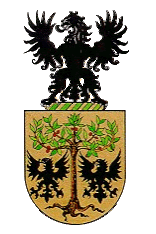
The pedigree of our family name predates much of the recorded history presented here. The name Ávila has roots in Avis or Avi, derived from Awi, an old Germanic word meaning "bird." Much of the historical heraldry and carvings in family castles and churches throughout Iberia include eagles, eggs, flowers, and symbols that some scholars associate with ancient Near Eastern traditions, suggesting possible connections to earlier civilizations. The 13 circles in blue on the coat of arms symbolize noble origin, referencing the fruit of life and sacred geometric traditions. Our family pedigree is well documented, with a pre-Roman presence in the Iberian peninsula and connections to some of the oldest kingdoms in recorded history.
Settlement of Ávila (11th Century)
Around 1088, King Afonso VI of Leon sent Raymundo of Burgundy, his son-in-law, to populate the city of Ávila (referred to as Abula by Ptolemy in his Geographia II 6, 60, located in the Iberian region of Bastetania). Dom Vasco Ximeno was one of the knights who contributed the most to his town. Vasco Ximeno and his wife, Dona Olaia Garcez, had two sons who contributed significantly to the city's settlement. They also had a daughter, Dona Ximena Vasques, wife of Dom Fernão Lopes Trillo, who served as Mayor of Ávila.
Ximeno Vaques was governor of the city of Ávila and served King Afonso VI at the site of Cuenca. From Ximeno Vaques and his wife, Dona Menga Munhoz, was born Vasco Ximenes.
The Dávila Lords (14th–15th Centuries)
Esteban Domingo Dávila (1365), a descendant of Nuño Rasura, took from Castile equal measures of wheat to offer as a gift for the construction and maintenance of the Church of Saint James. Esteban had children with Ximena Blázquez, niece of the lord of Villatoro. Gonzalo González Dávila (Señor de Villafranca y de Las Navas) and Gil González Dávila (first lord of Cespedosa and Puente de Congosto) succeeded him in his lineage. The Villafranca and Las Navas branch inherited the hereditary position of Mayor and councilor of Ávila, from which the Esteban Domingo Dávila Cuadrilla (civic district) was formed in the Ávila Council. He was buried in the chapel he founded in the San Francisco de Ávila monastery.
The Bethencourt Connection
Marie de Bracquemont, the granddaughter of Ana de Colombiers, married Jean de Bethencourt III (1332–1364). Jean was the son of Jean II and Isabeau de St. Martin (also known as Clermont). Isabeau was the daughter of Jean de Saint Martin-Le Gaillard, son of Guillaume V Plantagenet de Warenne, and Isabeau de Harcourt, daughter of the Baron of Harcourt.
From this marriage was born Regnault de Bethencourt IV (1364–1443), whose son Georges de Bethencourt (1389–1450) later married Elvira Gonsalves de Ávila, daughter of Esteban de Ávila and Ximena Blázquez, who had been married in Toledo (Lineage de Villafranca). This union produced Juan/João Sanchez de Ávila Bethencourt (1410–1482), who married Maria Vaz de Badillo.
The Azores (15th Century)
In the 15th century, Antão Gonçalves de Ávila traveled to the island of Terceira ("Island of Jesus Christ"), a Templar haven in the Azores. Antão (born 1440) was the son of João Sanches de Bettencourt de Ávila (1410–1482) and Maria Vaz de Badílho. Antão married Dona Inês Gonçalves de Antona, daughter of Afonso Gonçalves de Antona Baldaia, who was a servant of Infanta D. Beatríz of Portugal, Duchess of Savoy by marriage. Antão settled on the island, and from this marriage descended one branch of the Ávilas of the Azores.
His brother, João Gonçalves de Ávila, after serving the Portuguese crown in Africa, also married and had a daughter, Leonor Álvares de Ávila.
Separately, Afonso Lopes de Ávila, a Castilian nobleman, came to Portugal in the service of the King of Portugal and as protector of Joanna of Trastámara. Afonso later married Lady Vasconcelos, sister to the Bishop of Ceuta.
João de Ávila and the Restoration Era (16th–17th Centuries)
Ioam/João de Ávila was born in Angra, Terceira, Azores—a grandson of Castilian nobles who had settled in the City of Angra in support of Holy Roman Emperor Charles V. The family remained after the conquest of the islands by Philip II of Spain in 1583, who ordered the construction of the largest castle fortification outside of Europe to protect North Atlantic commerce and new world trade routes. Spanish culture flourished during Philip's reign, marking the beginning of the "Spanish Golden Age."
A century after the arrival of his grandparents, João (April 26, 1596 – June 18, 1684) became the Captain of Ordinances of Angra do Heroísmo, overseeing customs and administration of the Portuguese Companhia Geral de Comércio from Brazil on the island of Terceira and its annexes. He distinguished himself during the Restoration on the island of Terceira and is regarded as an exemplary hero—successive chroniclers presented him as a model of patriotism and dedication to the common cause during Portugal's War of Restoration in 1640.
As the grandson of "The Castilians," as they were known on the island, he studied at the Colégio dos Jesuítas de Angra do Heroísmo. At a young age, he chose commerce as his vocation.
In 1618, at just 21 years of age, he was appointed Ensign to the orderly company of Diogo do Canto e Castro, a cousin via Galicia. While serving in these militias, he distinguished himself in military service both at sea and on land, participating in several operations to defend the island and support ships in the Indies. He was appointed to the Municipal Council of Angra, a position he held in 1641 when the December 1640 Revolution that began the Portuguese Restoration arrived on Terceira Island.
As the most senior councilor of the City Council, he placed himself decisively at the service of the Portuguese Restoration, leading the faction that defended the revolt against the Spanish garrison stationed in the Castelo de São Filipe do Monte Brasil. In this role, he was one of the most active commanders in the siege of the castle. The post located next to the Boa Nova Hermitage was considered the most dangerous, as it was closest to the castle entrance. He traveled to neighboring islands to raise infantry and cavalry. After the castle's surrender, he was appointed Captain of Ordinances of Angra and received the honor of Knight of the Order of São Bento de Avis; he later became a Templar Knight.
The Valladolid Connection
João de Ávila's grandfather, Cristóvão da Cruz de Ávila, was born in Valladolid, the center of the Spanish and Holy Roman Empire monarchy. Appointed Captain-General of the armed forces, he came to the island to manage new world conquests and trade routes on behalf of the Holy Roman Empire.
Esteban da Cruz de Ávila also initiated significant changes in the arts and civics, serving the monarchy in establishing institutions that supported learning and cultural development in Spain during the Renaissance era. He is revered to this day in the history of Valladolid.
Dukedom of De Avila e Boloma (link)
Duque António José de Ávila (8 March 1807 – 3 May 1881
After completing his local studies, he traveled to Coimbra to study at the University in 1822, receiving a bachelorsdegree in Philosophy in 1826. While at Coimbra he also frequented some courses in Mathematics and entered the first year studies in Medicine, but he did not show any particular interest in politics. During the Liberal Wars (1832–34) he returned to Horta (the liberal government-in-exile escaped to the Azores during this period), where he taught for several years before becoming a politician of some success. As mayor through D. Pedro's liberal regency, António José was instrumental in obtaining a new charter, that elevated Horta to the status of city (4 July 1833).
After the War (1834), Ávila was elected to the Cortes, beginning an active and uninterrupted career that would last for the next 47 years, in different positions, in parliamentary and governmental roles, as well as a period in the Chamber of Peers (taking on the leadership of the group from the Duke of Loulé, from 1872 until May 1881). He was, as his biographer once wrote: "...one of the more distinct parliamentarians in the history of Portuguese constitutionalism...".[1] In actuality, in the 11 legislatures that he participated, during 27 years (between 1834 and 1861) he participated in 30 commissions in the Chamber of Deputies,[2] and 40 in the Chamber of Peers (between 1861 and 1881); he was involved in 2000 interventions. He did not limit himself to representing the citizens of Horta; during his many years in parliament he represented populations in Évora, Beja, Estremadura, Beira Alta, Chaves, Vila Real and Oliveira de Azeméis.
The family heirs were moved to live in the island of CORVO during the many threats of the time. Later in trying to gain passage to America they came to land again in Terceira.
Emigration to the United States (20th Century)
Following the Carnation Revolution of 1974, political unrest on the islands led to the family's emigration to the United States. In the turmoil of that era, João Corvelo DeAvila was wrongly accused of involvement in civil disturbances despite having been bedridden during the events in question. The family who had led the Restoration of 1640 and had ruled over Antlia found themselves displaced by circumstances beyond their control, ultimately beginning a new chapter in America.



Understanding Our Heraldic Tradition
During ancient times, the Roman "V" was read as a "U." Historically, the De Áuilas—later the De Ávilas—were known by a name connected to the Aquila constellation, according to family tradition.
Our pedigree was preserved on an island where time defied the odds—a place where history combined with the largest collection of coats of arms, a unique location where the preservation of lineage, customs, and traditions found safety over the centuries. It became a time capsule in an ever-changing world.
The Meaning of Ávila
Ávila is a name of Germanic origin meaning "bird" or "desired." This ancient Germanic name is thought to derive from the Norman-French names Aveline or Avis.
The Black Eagle in Heraldry
The black eagle breeds in tropical and subtropical Asia, with the subspecies perniger found in the Himalayan foothills through Nepal into the Indian states of Himachal Pradesh and Jammu & Kashmir, as well as peninsular India and Sri Lanka.
In German heraldry, the eagle was a symbol of the god Jupiter and became an emblem of the Roman Empire. It was adopted by Charlemagne, who saw himself as heir to the Roman imperial tradition. This symbolism passed to the emperors of the Holy Roman Empire, who were also—in most cases—the German Kings.
The eagles in the coat of arms of our branch of the De Ávila family represent our connection to Austria and the Holy Roman Empire.

Military Orders


Family Titles
-
Ottonian Dynasty
-
Astur-Leonese
-
Duque Pedro of Cantabria
-
Royal Celtic houses
-
Counts of Castile
-
Counts of Burgos
-
Counts of Ávila
-
Duques de Ávila
-
Duques of Cantabria
-
Marquis of Ávila
-
Marquis de la Puebla
-
Lords of Peñaranda
-
Lord of San Bartolomé de Pinares
-
Counts of Correia Bettencourt
-
Marquis of Navalmoquende
-
Lords of Villafranca de la Sierra de Gredos
-
Counts of Valbom
-
Counts of Vila da Praia da Vitória
-
Lords of Villatoro
-
Viscounts of Burgos
-
First Lords of Las Navas
-
Marquis of Povar
-
Marquis of La Puebla
-
Marquis of Cespeda
-
Knights of Avis
-
Knights of Christ (PT)
-
Seniors de la Cespedosa & Torres
-
Baron do Ribeiro Viscount of Bettencourt
-
Counts of Correia Bettencourt
-
Duke of Ávila and Bolama
-
Dukes of Austria
-
Dukes of Burgandy
-
Visigoth Dynasty
-
Counts of Amaya
-
House of Capet
-
Royal House of Toledo
-
House of Trastamara
-
Princes of Saxony
-
Counts of Lara
-
Royal house of Castile
-
Royal house or Germania
-
Royal House of Habsburg
-
Royal House of Austria
-
Royal House of Cantabria
-
Royal House of Spain
-
Royal House of Savoy
-
Royal House of Netherlands
-
Royal House of Portugal
-
Royal house of France
-
Royal House of Sicily
-
Royal House of Naples
-
Royal House of Sardinia
-
Royal House of Serbia
-
Holy Roman Empire
-
Merovingian Dynasty
Family Cadet Branches
-
Casa de Arias Dávila
-
Casa de Velada
-
Casa de los Valderrabanos
-
Casa de Dávila-Ponce de León
-
Casa de Velázquez de Cuellar
-
Casa de los Bracamonte
-
Casa dos Castros (In ES and PT, the 222 and the 454 coat of arms are used by the descendants of Lain Calvo, as he was Nuño Rasura's son in-law, both historically known as the legendary judges of Castile, same family pedigree)
Helpful Links
Other Pedigree Notables
-
US President George Washington
-
US President Ulysses S. Grant
-
Osawatomie Brown
-
PM Winston Churchill
- Agnes Harris (Scotland)
-
HM George I
-
WM Von Bizmarck
-
HRE Ferdinand I
-
HRE Charles VI
-
HM Margrethe II
Family Coats of Arms




_svg.png)


